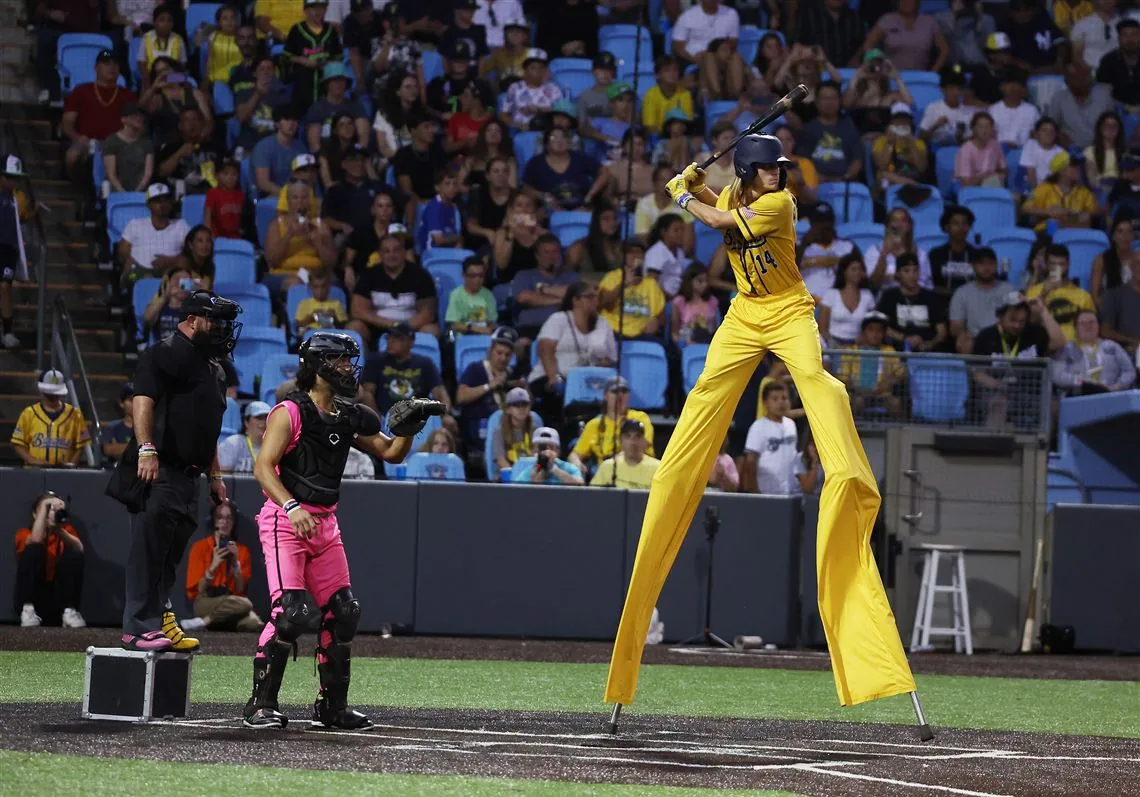
The Golden Batter rule lets a Banana Ball team, once per game, send any hitter already in its lineup to bat in any spot. It is a temporary batting-order override designed to put a preferred hitter at the plate when the game is on the line. The scheduled hitter does not automatically leave the game; the official example says that player remains but skips that turn, after which the order continues. If the chosen hitter is still on base when his normal spot arrives, the displaced hitter can become the pinch runner, or an eligible Designated Pinch Runner can run. The rule can even create consecutive plate appearances for the same hitter. Those mechanics make timing strategic, but the current public rule does not restrict use to the ninth inning or require teams to choose the player with the best season statistics.
What the Golden Batter Rule Allows
Rule 11 creates one controlled exception to the normal expectation that hitters bat in listed order. A team can spend its single Golden Batter use to call any hitter in the lineup to the plate in the batting spot that is due. The player is “golden” for that appearance because of the rule’s use, not because one permanent roster member holds a special position all season.
The official purpose is direct: let a team’s best hitter bat when the game is on the line. Jesse Cole’s launch explanation compared the idea with other sports, where a top player can receive the ball for the decisive attempt. Baseball’s batting order can otherwise leave a club’s strongest option several places away when the final opportunity arrives.
That purpose should not be read as an automatic statistical command. “Best” could reasonably depend on the pitcher, handedness, contact need, power need, baserunners, or how a hitter is performing that night. Those are tactical interpretations, not extra eligibility rules. The binding public language is broader and simpler: any hitter in the lineup, any spot, one time in the game.
The phrase “in the lineup” also keeps this from being accurately summarized as a free choice of anyone on the bench. Rule 11 describes rearranging a current hitter’s turn, while other substitution and designated-player provisions address different jobs. When reviewing Banana Ball teams, focus first on the active batting lineup. Later sections explain how the scheduled spot resumes and why the chosen hitter can sometimes appear twice in succession.
Who Is Eligible to Be the Golden Batter?
The current eligibility test begins with the official noun: the team may choose any hitter in the lineup. That includes the freedom to select a hitter whose normal spot is earlier or later than the spot currently due. The team does not have to announce one permanent Golden Batter before every game in the public rule, and the player need not be the same choice in every contest.
- Lineup status: Is the candidate one of the hitters in the game’s batting lineup?
- Team inventory: Has the club already exercised its one Golden Batter use?
- Current spot: Is another lineup position due, creating the spot into which the selected hitter will bat?
Those checks establish the published core. Several popular assumptions go farther than the text:
| Claim | What the current public rule supports |
|---|---|
| Only the highest-average hitter is eligible | No. The team may choose any hitter in the lineup; “best” expresses the goal, not a statistical formula. |
| The choice must be predesignated before first pitch | No such universal requirement appears on the public Rule 11 page. |
| Any bench player can enter as Golden Batter | Not from Rule 11 alone; its eligibility wording is limited to hitters in the lineup. |
| The chosen hitter must be a position player | The rule says hitter in the lineup and does not add that positional restriction. |
Banana Ball lineups can contain designated-hitter and extra-hitter roles under the site’s other need-to-know provisions. That fact does not change Rule 11’s test: look at who is actually a hitter in the lineup for that game. The public page does not resolve every injury, removal, or eligibility edge case, so those should be left to current game administration rather than answered by analogy to MLB substitution rules.
What Happens to the Scheduled Hitter and Batting Order?
The official page answers this with a numbered example. Imagine the sixth, seventh, and eighth spots are due. Hitters No. 6 and No. 7 make the first two outs. Instead of sending No. 8 to the plate, the team activates Rule 11 and sends its No. 3 hitter as the Golden Batter.
| Moment | Who is involved? | What happens to the order? |
|---|---|---|
| Before activation | No. 6 and No. 7 complete their turns | No. 8 is ordinarily due next |
| Golden Batter appearance | No. 3 bats in the No. 8 turn | No. 8 does not take that plate appearance |
| After the appearance | No. 8 remains in the game | No. 9 is the next hitter |
| Later cycle | Lineup reaches those positions again | The established order continues; Rule 11 was a one-time use |
The crucial distinction is between skipping a turn and replacing a player. In the official example, the No. 8 hitter stays in the game even though No. 3 took that plate appearance. The Golden Batter does not permanently inherit the No. 8 slot, and the club does not restart the lineup from No. 3. No. 9 follows.
This is also why ordinary pinch-hitter assumptions can produce the wrong answer. Under familiar baseball substitution concepts, a pinch hitter often replaces someone in a batting-order position. Rule 11 publishes its own continuity example instead: the scheduled hitter stays, misses that turn, and the next position follows. Banana Ball’s specific instruction should control over an MLB analogy.
While following a live Banana Ball game, annotate the event separately from the permanent lineup: “Golden Batter No. 3 in No. 8 turn; No. 9 next.” That note preserves both facts—the special plate appearance and No. 8’s continuing game status. Formal statistical notation is not specified on the public page, so this is a viewing aid rather than an official scoring symbol.
What If the Golden Batter Is Already on Base?
The Golden Batter can reach safely and remain on base long enough for the lineup to cycle toward his ordinary position. That creates a practical conflict: the same player cannot stay as a runner and also step into the batter’s box when his scheduled turn arrives. The official example resolves that exact situation.
Continue the No. 3-for-No. 8 sequence. No. 3 took the Golden Batter appearance in the eighth spot and reached base. The order continued to No. 9 and then moved toward the top. If No. 3 is still a runner when the regular No. 3 spot becomes due, the official rule says No. 8 becomes the pinch runner. No. 3 is then free to take his scheduled plate appearance.
- No. 3 appears early as Golden Batter in No. 8’s turn.
- No. 3 reaches base; No. 9 becomes the next scheduled hitter.
- The offense keeps the inning alive until the normal No. 3 position returns.
- No. 8 takes over as the runner, allowing No. 3 to bat in his own spot.
The page offers another possibility: if eligible, the team’s Designated Pinch Runner may run. The qualification matters. Rule 11 does not say that any bench player can automatically replace the runner or that the Designated Pinch Runner ignores the eligibility cycle published elsewhere. Use the option only as the official sentence states it—when eligible.
This mechanic preserves two identities that a casual summary can blur. No. 8 remains the lineup’s No. 8 hitter even after losing one turn to the Golden Batter, and No. 3 remains the No. 3 hitter despite the extra appearance. Moving No. 8 to the base in the collision is a practical running solution; it does not retroactively turn the Golden Batter into a permanent eighth-place substitute. Rare situations beyond the published example should be left to current officials rather than extrapolated into a universal rule.
Can the Golden Batter Hit Back-to-Back?
Yes. The official page says the Golden Batter can technically hit back-to-back in one inning if the team chooses. “Back-to-back” means two consecutive plate appearances by the same hitter, each with its own outcome. It does not mean the player receives two swings inside one at-bat or that the team spends two Golden Batter uses.
The sequence requires lineup adjacency. Suppose No. 2 is due and No. 3 is the preferred hitter:
- The team uses Rule 11 and sends No. 3 to bat in No. 2’s turn.
- No. 3 completes the Golden Batter plate appearance.
- The normal order advances from the skipped No. 2 turn to the regular No. 3 spot.
- No. 3 bats again, now in his ordinary lineup position.
The first appearance is the one-time override; the second is not another special selection. It arrives because No. 3 was already next in the written order. If the team instead used No. 3 in the No. 8 turn, No. 9 and the top of the lineup would separate the appearances unless the inning continued long enough for No. 3’s usual position to return.
A widely shared 2026 Banana Ball clip offered a vivid real-game illustration: Jackie Bradley Jr. reportedly singled, returned shortly afterward under the Golden Batter rule, and homered. That event is useful evidence that teams exploit consecutive-opportunity timing, but the general rule should still be learned from the official page rather than one highlight.
Browse available Banana Ball videos with the lineup sequence in mind. When the same face appears twice, ask which batting spot was due for the first appearance and whether the second was the hitter’s ordinary turn. That distinguishes a legal Golden Batter sequence from a mistaken claim that the lineup simply restarted.
When Should a Team Use the Golden Batter?
The rules answer what a team may do; they do not publish a mandatory decision formula. The safest strategy discussion therefore starts with the official goal—getting a preferred hitter to the plate when the game is on the line—and labels everything else as analysis.
| Decision factor | Reason to use now | Reason to wait |
|---|---|---|
| Point leverage | This plate appearance can swing a valuable inning or final-inning run | The current inning has limited effect and a later chance is plausible |
| Outs and runners | Runners are aboard with enough outs remaining for a productive result | Bases are empty or the inning situation reduces the expected impact |
| Hitter-pitcher matchup | The chosen hitter’s skills fit the current pitcher | A different lineup hitter may be better suited, or the opponent may change pitchers |
| Lineup adjacency | Using the hitter now could create consecutive appearances | The selected hitter’s normal turn is already close and may arrive without Rule 11 |
| Game remaining | There may be no meaningful later plate appearance | Several high-leverage paths still appear likely |
Banana Ball’s scoring makes “leverage” context-sensitive. Most innings award a point to the team that scores more runs in that inning, while every run counts in the final inning under the current rules. A single plate appearance can therefore matter differently depending on the inning, the current run comparison, and whether final-inning scoring is active. That does not create a special Golden Batter restriction; it changes the value of the opportunity.
Waiting carries its own risk. A manager can preserve Rule 11 for an imagined perfect situation that never arrives, especially under a timed, fast-moving format. Using it too early can also waste the chance before the game’s highest-pressure moment. The strategic question is not “late or early” in isolation. It is whether the present advantage exceeds the realistic value of holding the option.
Lineup mechanics should be part of that comparison. An adjacent regular spot may give the chosen hitter two consecutive appearances, but it can also create the on-base collision described earlier. Teams must also decide what they give up when the scheduled hitter skips a turn. Fans can consult the Banana Ball standings for broader competitive context and the latest scores for outcomes, but those pages cannot prove why a manager made one in-game choice. Without a team’s stated explanation, motive remains informed analysis.
Common Golden Batter Questions and a Watch-Along Checklist
Is one player automatically the Golden Batter all season?
No. The rule allows the team to send any hitter in that game’s lineup. The stated goal refers to the “best hitter,” but it does not name a permanent role or publish a season-stat threshold. Choice can change with the lineup and game situation.
Does the scheduled hitter leave the game?
Not in the official No. 3-for-No. 8 example. No. 8 stays in the game but does not bat in that turn, and No. 9 follows. This is the clearest reason not to describe the mechanism as an ordinary permanent pinch-hit substitution.
Can a club use the rule twice?
No. Rule 11 says one time in a game. A hitter’s back-to-back sequence is not two uses: the first plate appearance is the Golden Batter override, and the second is the hitter’s regular lineup turn.
Must it happen in the ninth inning?
No current public restriction says ninth inning only. The rule’s origin and examples emphasize late, consequential moments, and real Golden Batter appearances have occurred in late innings. That describes purpose and usage, not an inning gate. “Any spot” and “one time a game” are the operative public limits.
Can the team choose someone from the bench?
Rule 11 itself says any hitter in the lineup. It should not be cited as independent authority to summon any bench player. If another substitution rule makes someone part of the lineup, that is a separate eligibility step; the public Golden Batter sentence alone does not supply it.
Is there an official Golden Batter scorecard symbol?
The public rules page does not publish one. A fan can use “GB” or highlight the plate appearance as a personal notation, but should label that as a viewing convention. The important record is who was due, who batted, what happened, and who followed.
Watch-along checklist
- Write down the lineup spot that was due.
- Identify the hitter selected under Rule 11.
- Record the Golden Batter plate appearance and outcome.
- Confirm that the next normal lineup spot follows.
- If the hitter remains on base when his regular turn returns, note the official runner solution.
- Mark the team’s one Golden Batter use as spent.
Use the Banana Ball calendar to plan a game or the games-today page to follow current action. The compact rule to remember is: one use, any current lineup hitter, any due spot, then the order continues. The on-base and consecutive-appearance examples are not exceptions to that sentence; they show how it works when the lineup catches up.
Comments
Comments are reviewed before publication. Spam, personal information and abusive content are not published.
Loading comments…