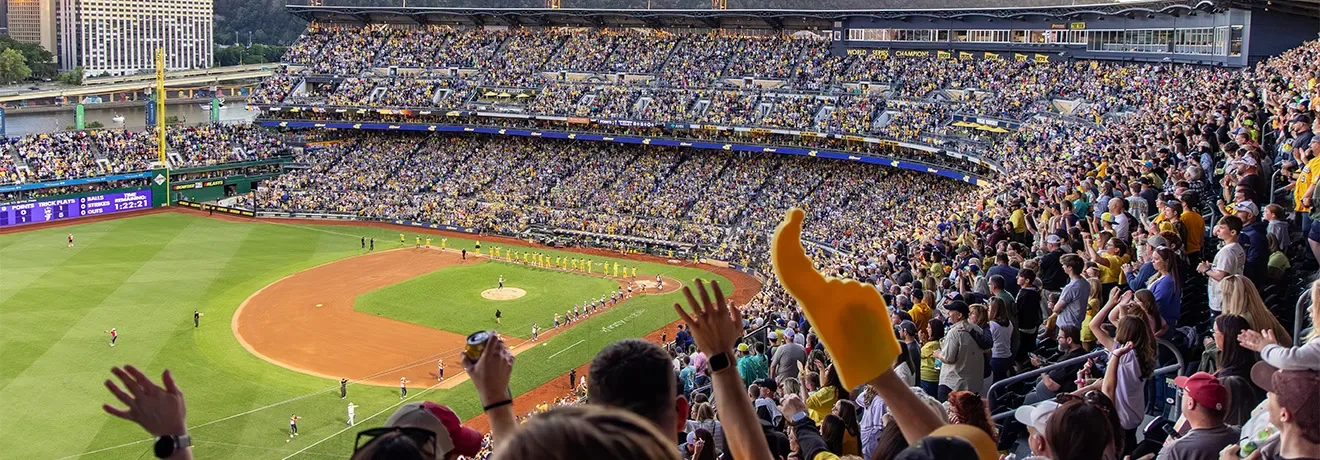
A Banana Ball Showdown is the tiebreaker used when the point score is still level at the end of the game's two-hour limit. It is not a conventional extra inning. Instead, each club receives a stripped-down scoring opportunity built around one hitter, one pitcher, a catcher and, depending on the round, zero or one fielder. The first two rounds allow no more than one point per club; later rounds begin with loaded bases and can produce as many as four. An over-the-wall home run ends the game immediately. The current rules also give ball four its own Showdown procedure, so a “walk” does not work like either MLB or Banana Ball's normal ball-four sprint. This guide follows the current official rule page and explains every stage in order.
What Is a Banana Ball Showdown and When Does It Start?
The Showdown is Banana Ball's answer to a tied game. Under the current official rules, it begins when the game remains tied at the end of the two-hour time limit. Rather than sending nine defenders back onto the field for another complete inning, Banana Ball creates a sequence of short, exposed pitcher-versus-hitter situations. The defensive alignment changes as the rounds advance, but the basic question stays the same: can the offensive side turn its opportunity into the points allowed in that round?
When a hitter scores in an early Showdown round, the club earns one point. When the hitter is retired, the club earns nothing; the official rules call that outcome a Showdown Shutdown. Both outcomes are recorded within a tiebreaker structure, not as an ordinary regulation inning. That distinction matters when reading the final Banana Ball score, because points determine the winner even though runs and baserunner movement explain how the Showdown opportunity developed.
For a live game, start with the status on Banana Ball games today. If regulation closes with equal points, watch for players to leave the field and a minimal defense to take shape. Do not assume “extra innings” means another top and bottom with standard personnel. Each club gets its opportunity under the round's limits, the scores are compared, and the format escalates if neither side has separated itself. The rare, immediate exception is an over-the-wall home run, which ends the entire game at once.
Banana Ball Showdown Rounds at a Glance
The personnel change by round. The official sequence is easier to understand as a field-and-scoring matrix:
| Stage | Defense | Offense | Starting runners | Maximum points |
|---|---|---|---|---|
| Round 1 | Pitcher, catcher, one fielder | One hitter | None | One |
| Round 2 | Pitcher and catcher | One hitter | None | One |
| Round 3 | Pitcher, catcher, one fielder | One hitter | Bases loaded | Four |
| Later rounds | Pitcher, catcher, one fielder | One hitter | Bases loaded | Four |
Round 1 is the closest match to the familiar “one-on-one” description, but that label is incomplete. A catcher still receives pitches and one selected fielder covers the enormous area between the foul lines. Round 2 removes that fielder, so a fair ball that escapes the pitcher can force the pitcher and catcher to solve a much larger defensive problem. Round 3 restores one fielder while putting runners on all three bases. The defensive help returns, but the offense now has four possible runs—including the hitter—to convert into points.
After Round 3, the rules do not cycle back to Round 1. The clubs continue using loaded bases and one fielder until one has won. That makes the round number essential context: a score in Round 1 can represent the entire one-point allowance, while a run in a later round may be only part of a four-point opportunity. The official rule does not assign a mandatory position to the lone fielder, so do not infer “shortstop,” “outfielder,” or any other fixed spot from the table. Clubs drawn from the Banana Ball teams must make that tactical choice for the matchup in front of them.
How Showdown Scoring and a Showdown Shutdown Work
Showdown scoring uses the same crucial vocabulary as the rest of Banana Ball: points decide the game; runs describe how scoring happens. In Rounds 1 and 2, a club may earn no more than one point. If its hitter completes the scoring task, that point is the entire offensive return for the round. If the defense records an out first, the result is zero points and a Showdown Shutdown. A second club operating under the same one-point ceiling can therefore match the score or create separation.
Consider a hypothetical Round 1. Club A's hitter puts a ball into the gap, circles the bases and reaches home safely: Club A earns one point. Club B's hitter grounds a ball that the lone fielder retrieves and relays for an out: Club B earns zero. The events include a run and an out, but the game-level comparison is one Showdown point to none. A viewer checking the Banana Ball scores should read the points result first, then use the play sequence to understand how it was earned.
Rounds 3 and beyond expand the ceiling because they begin with three runners aboard. Every run counts as a point, up to four when the three placed runners and hitter all score. For example, three runners scoring would produce three points in that opportunity; it is not automatically rounded into a one-point inning win. That higher ceiling is why late Showdown numbers can look dramatically different from Rounds 1 and 2.
The practical rule is simple: never compare a one-point early round with a four-point later round without noting the format. Check the current BBCL standings for the official team picture, but use the final score page—not a raw run total—to determine who won. Broadcast graphics may present the tiebreaker in different layouts; the official distinction between points and runs remains the reliable guide.
The Ball-Four Rule in Showdown Rounds 1 and 2
Ball four inside a Showdown now follows a special placement sequence. It is not an MLB walk to first, and it is not the normal Banana Ball sprint in which the defense must have every fielder touch the ball. In Round 1 or 2, the first ball four puts a runner at second base. The hitter who earned it may remain at the plate with a reset count if the manager wants that outcome. The manager may instead send another batter and may designate which player becomes the runner.
- First ball four: place the selected runner at second, reset the count, and choose whether the same hitter continues.
- Contact after that placement: if the batter puts the ball in play and the runner from second scores, the club has earned the one point available and the round ends.
- Second ball four: advance the runner from second to third and reset the count again if the manager keeps the plate appearance going.
- Third ball four: the runner advances home, giving the offense the one point it needs in that round.
Suppose a manager selects Runner A after the first ball four. Runner A begins at second while the original hitter—or a replacement—faces a fresh count. A hit that brings Runner A home completes the scoring objective. If another ball four occurs instead, Runner A moves to third. One more ball four pushes Runner A across home and supplies the point. The batter does not simply stack conventional walks by occupying first base at every step.
This procedure creates two decisions after the first ball four: who is best suited to run from second and who is best suited to produce the next ball in play. Those are strategic implications, not extra written rules. For score-reading purposes, track the placed runner and the number of ball-four events. That avoids the two most common errors—expecting the full-defense touch relay and assuming the first ball four instantly scores the round.
The Ball-Four Rule in Bases-Loaded Rounds
Round 3 and every necessary later round begin with the bases loaded, so the same ball-four call must account for three existing runners and the four-point ceiling. On the first ball four, two runners score, while runners are placed at second and third. The batter may continue with a reset count if the manager chooses. At that moment, the club has two points from the opportunity and two runners who can supply the remaining two.
- Start: runners occupy first, second and third, with a hitter at the plate.
- First ball four: two runners score; the remaining configuration is runners at second and third, with the count reset for the continuing or newly chosen hitter.
- Contact next: if a ball in play brings both runners home, the offense reaches the four points allowed and the round ends.
- Second ball four instead: the runner at third scores and the runner at second moves to third.
- Third ball four: the final runner scores, completing the four-point total.
The easiest viewing shortcut is to reset the picture immediately after that first call: two points have scored, second and third are occupied, and two more points remain available. Do not apply a conventional bases-loaded walk, which would normally force only one runner home and award first base to the batter. Do not apply the normal Banana Ball all-fielder relay either. The official Showdown placement sequence is its own system.
The manager's options still matter because the hitter can remain or be changed and the runner can be designated after ball four. But the placement outcome itself is not discretionary. For a fan, the reliable sequence is two points, then a chance to bring home two runners; if additional ball fours follow, one more runner scores on each until the four-point target is complete.
What Runners Cannot Do During a Showdown
Two current restrictions keep placed runners from turning the Showdown into an uncontrolled steal race. First, runners may not take leads. Second, they may not advance on a wild pitch or passed ball. Both restrictions apply in any Showdown round, including the early round after a ball-four runner is placed at second and the later rounds that begin with loaded bases.
This is a sharp contrast with a normal Banana Ball at-bat. Rule 5 ordinarily lets a hitter attempt to steal first on a passed ball or wild pitch. A fan who remembers that headline rule could reasonably expect every pitch that escapes the catcher to release the Showdown runners. The special tiebreaker language closes that route: runners stay attached to their bases rather than taking a head start or advancing because the pitch got away.
Movement instead comes from a ball put in play or from the official ball-four placement sequence described above. In practical viewing terms, keep your eye on the hitter until contact and do not count a point merely because a runner crosses during a loose pitch. The public rule page does not spell out a universal penalty for every attempted prohibited advancement, so this guide does not invent an automatic out, reset or award. The umpiring crew applies the rule in the live situation.
The restriction also explains why the count-reset procedure matters. Without free leads or wild-pitch advancement, the offense must either produce contact or accumulate the defined ball-four progressions. That preserves the isolated confrontation: the pitcher must throw competitive pitches, the hitter must solve the matchup, and the small defense must finish the play before the designated scoring runners reach home.
The Home-Run Walk-Off and What Happens After Round 3
An over-the-wall home run is the Showdown's override switch. The current rule says that if a home run clears the outfield wall at any point in the tiebreaker, it is a walk-off win and the game is over. Once that happens, stop calculating whether the round allowed one point or four and do not wait for the other sequence to be completed. The home-run ending takes priority.
That wording is more specific than simply saying “the hitter scores.” A ball kept inside the park can still create the ordinary Showdown points as runners reach home, but the public rule gives its automatic game-ending status specifically to a home run over the outfield wall. This guide therefore does not label every inside-the-park scoring play an automatic game winner. It is evaluated through the round's normal point comparison.
If no home run ends the contest and neither club has won after the first three Showdowns, the format continues rather than producing a tie. Each additional opportunity uses the Round 3 framework: bases loaded, one hitter, and a defense of pitcher, catcher and one fielder. Every run counts as a point, up to four, and the clubs continue until one has won. The sequence does not return to the empty-base first round.
For fans, that creates a clean decision tree. Ball clears the wall: the game ends immediately. Ball stays in the park: follow runners, outs and the current round's point limit. Still level after Round 3: expect another bases-loaded round. Highlights may later appear in the site's Banana Ball videos, but the live ruling and final score remain controlling; a replay clip should not be used to invent a different result.
How to Follow a Showdown as a Fan
You do not need to memorize every placement before the first pitch. Use this five-step checklist:
- Confirm the tie. A Showdown follows a tied point score at the end of the two-hour limit.
- Identify the round. Round 1 has one fielder, Round 2 has none, and Round 3-plus has one fielder with loaded bases.
- Know the ceiling. The first two rounds allow one point; the loaded-base rounds allow four.
- Track ball four separately. Look for a runner at second in early rounds or the two-points-plus-second-and-third reset in late rounds.
- Watch the wall. An over-the-wall homer ends the game immediately; otherwise follow the round comparison.
Three quick clarifications resolve most remaining confusion. A Showdown is not guaranteed to stop after three rounds; the bases-loaded format repeats if necessary. A passed ball does not release placed runners, because leads and passed-ball or wild-pitch advancement are prohibited. And “four points” does not apply to every Showdown: it is the cap only once the tiebreaker reaches the loaded-base format.
Before attending or watching, add the relevant game from the Banana Ball calendar. During and after play, use the scores page to distinguish live status from a final result. Then check the BBCL standings for the updated league picture rather than trying to infer it from one dramatic finish. Schedule and standings data can change; this rules guide explains the mechanism, while those tools supply the current event and competition context.
The best mental model is a ladder: one fielder, then no fielder, then loaded bases with one fielder until somebody wins. Overlay the point cap, the special ball-four placements and the home-run override, and even a chaotic Showdown becomes readable. When the official rules change, the official Banana Ball page should control over an older clip, recap or fan description.
Comments
Comments are reviewed before publication. Spam, personal information and abusive content are not published.
Loading comments…