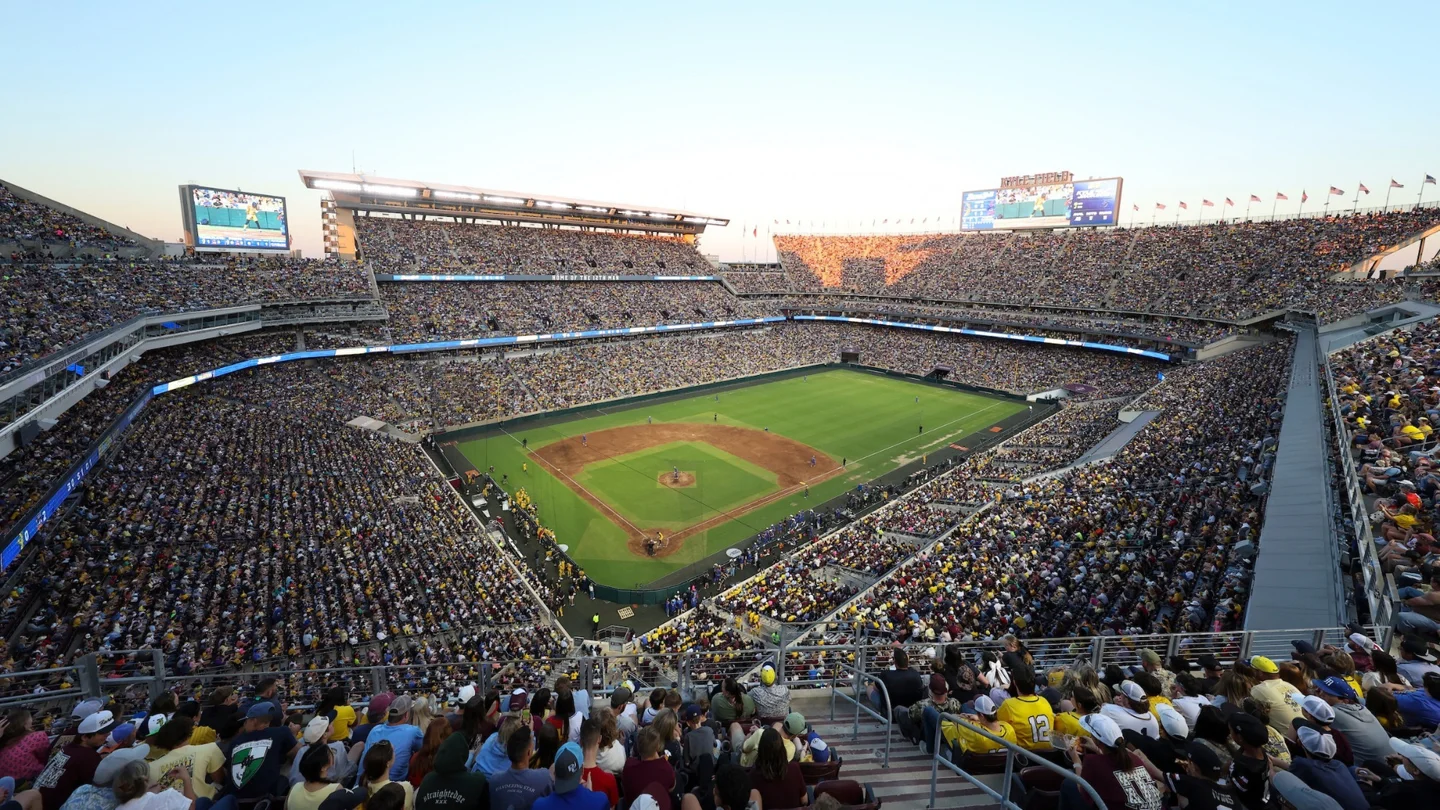
The Savannah Bananas played the Texas Tailgaters at Kyle Field on May 2, 2026, bringing Banana Ball into Texas A&M’s football home. That completed event offers a useful introduction to a stadium many Banana Ball fans first encountered through a very different sport. The venue connects the experiences; the playing surface, competition and admission arrangements still need to be understood separately.
What the May 2026 Banana Ball event actually was
A completed special event, not an Aggies baseball home game
Texas A&M’s original event announcement identified the matchup as Savannah Bananas against Texas Tailgaters on Saturday, May 2, 2026. The institution hosted a touring sports event at Kyle Field. It was not a Texas A&M varsity baseball game, and neither participating team became an Aggies team by playing there.
In its May 21 postevent report, Texas A&M Athletics reported an attendance of 102,000 and more than $21 million in direct economic impact, drawing on City of College Station information. The attendance describes this particular event. The economic estimate describes activity associated with the visit; it is not a statement that the university earned $21 million in profit.
Those distinctions help explain why the occasion attracted attention beyond Banana Ball’s regular audience. A touring competition occupied a stadium strongly associated with college football, while visitors also used hotels, restaurants and transport around College Station. The event therefore had a campus and city dimension alongside the action on the field. That is a more useful interpretation than treating the crowd figure as the whole story.
The timing of a source matters here. Before the game, the city’s April guide described an expected crowd above 96,000. The later university report supplied the postevent attendance figure. A forecast and a retrospective report answer different questions. When discussing what happened, use the later report with attribution rather than presenting an earlier expectation as the final count.
For fans discovering the story now, the original ticket instructions are historical material. The announcement’s lottery deadline belonged to the May 2026 event. It does not establish that another Kyle Field visit is on sale, that a new lottery has the same terms or that a particular seat can still be purchased. A future trip begins with a newly confirmed event and its own official ticket process.
The enduring interest is how a familiar entertainment product changed the way people saw an established football venue. Someone arriving for Banana Ball could discover the campus setting without already following Texas A&M football. Someone familiar with Kyle Field could see the stadium organized around a different game. Both viewpoints are valid, provided the event is described in the past tense and the separate teams and competitions remain clear.
Why a football stadium changes the Banana Ball viewing question
Kyle Field’s scale comes from its football role. The official facility history identifies it as the Aggies’ home since 1905 and describes the redevelopment that debuted for the 2015 season. Its published football seating capacity is 102,733. That number describes the stadium’s football configuration, not a promise that every special event sells an identical inventory of seats.
The practical issue is where the new game sits within the existing bowl. A football view and a Banana Ball view ask the spectator to follow different shapes of play. Familiarity with a section number does not establish the distance or angle to the action when another field is installed. The correct reference is the event’s own seating map and any stated viewing limitations.

Think about what you want to see. Following a complete play, watching performers between plays and hoping for nearby interaction are different priorities. A seat that gives a broad overview can make the converted field easier to understand, while a closer location may emphasize a smaller part of the show. Neither choice guarantees an interaction, and proximity should be judged from the actual event layout.
Photographs are helpful when they show the relevant configuration. A football image can explain the stadium bowl and campus context. A Banana Ball image can show how the event occupied that space. They should not be exchanged without explanation: a normal football photograph cannot prove where a temporary foul line, performance area or event obstruction was located.
That is also why it is unnecessary to invent engineering details to explain the conversion. The university’s report establishes that Kyle Field was transformed for the event. It does not, by itself, supply a construction plan, base-path measurements or a full account of temporary materials. The fan’s useful question is how the published setup affects the experience, not how confidently an article can guess the installation method.
The attendance figure and football capacity likewise belong in separate columns of your mental picture. One reports a specific event; the other describes a venue configuration. Neither alone reveals whether a particular seat had the view a particular fan wanted. A large crowd can establish the occasion’s scale without settling the personal question of which viewing position would suit your group.
The 12th Man belongs to Kyle Field’s football story
Learn the campus context without importing another sport’s rules
The “Home of the 12th Man” lettering is more than a description of a large crowd. Texas A&M’s official account of the tradition traces it to E. King Gill, who suited up and stood ready to help an injury-depleted team at the Dixie Classic on January 2, 1922. That game was in Dallas, not at Kyle Field. Gill’s readiness, rather than an appearance in the game, became the lasting symbol.
The university connects the story to service and solidarity, including the student section’s tradition of standing during football games. For a Banana Ball visitor, learning that context adds meaning to a sign or a crowd scene that might otherwise look like generic stadium decoration. The venue carries a history that predates the touring event and continues when its temporary field is gone.
There is no need to translate that tradition into Banana Ball’s rules. Audience participation can be central to two sporting experiences while operating in different ways. A university’s symbolic “12th Man” does not mean an additional player may simply enter a football play. Equally, hosting Banana Ball does not turn the touring game into a college football competition or replace the visiting teams’ identities with A&M’s.
Fans can appreciate those layers without having attended the university. A first visit might begin with the show, a photograph or a family member’s interest. A later question about the name on the stadium can lead to the school’s own history. That is a reasonable way to discover a campus; it does not require inventing a connection between an individual Banana Ball player and the Aggies.
When discussing the event, keep those connections at the level the evidence supports. The teams played in Texas A&M’s football stadium, the institution hosted the occasion and a large audience experienced the setting. None of that establishes a player’s private football loyalties or an official endorsement of an unrelated travel product. The interesting story is already strong without those additions.
If the football atmosphere now interests you, learn a little before choosing a game. The university’s traditions pages explain the background more reliably than a short clip detached from its occasion. Then decide whether you want to see the stadium during an Aggies game, visit the campus at another time or simply retain the Banana Ball memory. Each is a different way to relate to the place.
What connects them is attention to context. The touring event introduced a new audience to Kyle Field; the stadium’s established traditions explain why that location was distinctive. Keeping both stories visible allows Banana Ball fans to enjoy the crossover while understanding that the campus has its own sporting life beyond that one evening.
A return visit needs a fresh event plan
If the May event inspired you to return, start by naming the experience you want next. Another Banana Ball tour stop, a Texas A&M football home game and a non-game campus visit are three different plans. None follows automatically from having attended the first event. Each needs a confirmed date, appropriate access and an event-specific route to the venue.
For future Banana Ball travel, our venue directory is a place to examine the tour stops currently listed, and the Banana Ball calendar tools help you keep selected dates organized. Check the season displayed: the tools now emphasize 2027, while this article discusses a completed May 2026 event. A photograph of Kyle Field from that evening is not evidence of a newly announced return there.
For football, the related site in our project, College Football Schedule, offers a different starting point. Its Texas A&M schedule page can help identify an opponent and date among the entries it tracks. Then consult the Aggies’ official football schedule to settle the venue and latest kickoff information. A football game involving A&M can be away from College Station; the university name alone is not the travel destination.
Rebuild the operational plan around that event. The City of College Station’s April 2026 Banana Ball guide contained a specific gate-opening time, show start, parking arrangements and road-closure advice. Those details belonged to that occasion. They are useful historical evidence of how much planning a large event involved, but they should not be pasted into a football itinerary months later.
Use the university’s current Kyle Field football guide for the appropriate maps and game-day information. Confirm the ticket in your own account, its entrance instructions and any accessibility arrangement relevant to your group. If you plan to park, identify the correct product and access route before traveling. A remembered space or an old parking screenshot is not a reservation for a different event.
Allow the shape of the new day to determine the extra activities. A confirmed kickoff leaves a different planning question from an unassigned time window. A family that wants a relaxed visit might choose one main event and one optional stop, leaving the rest open until the schedule is clearer. A group returning for a specific opponent may prioritize that game and make everything else secondary. Both approaches are more reliable than reproducing the May timetable.
The useful legacy of Banana Ball at Kyle Field is therefore more than a crowd record. It gave visitors a reason to notice a university stadium, its surroundings and its traditions through a sport they already enjoyed. A later visit can deepen that connection when it begins with fresh, event-specific information. The memory can carry forward; the old ticket terms and gate times should remain with the event to which they belonged.
Comments
Comments are reviewed before publication. Spam, personal information and abusive content are not published.
Loading comments…