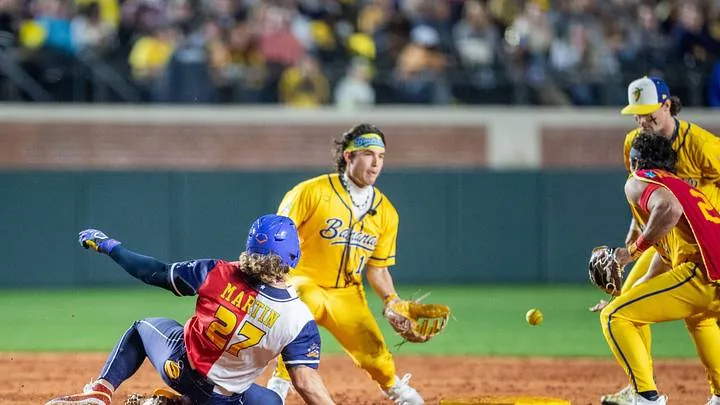
A Banana Ball Ball-Four Sprint begins when the pitcher throws ball four. Instead of receiving an ordinary walk to first, the hitter starts running and may try to take as many bases as desired. The defense must complete its required touches before the ball becomes live; the current official rule specifically says the ball does not have to touch the pitcher or catcher. Once the condition is complete, the defense can make a live play on the advancing hitter. That simple race creates the excitement, but it also creates myths. The public rule does not prescribe one fixed fielder order, promise a particular base, or explain every right of runners who were already aboard. This guide separates the official mechanics from practical strategy so you can follow the play without filling those gaps with guesses.
What Happens on a Banana Ball Ball Four?
The pitch count still matters. “No walks allowed” does not mean an umpire stops calling balls or that the plate appearance can continue forever. It means the fourth called ball triggers a different result from the familiar award of first base. For a viewer, the cleanest way to understand the play is to follow four phases:
- Ball four is called. That call starts the special rule. It is not the same trigger as a passed ball or wild pitch that allows a hitter to try to steal first.
- The hitter runs. The official page says the hitter may advance to as many bases as desired. “May” matters: the hitter chooses whether to keep pushing based on the developing play.
- The defense completes the touch requirement. Every required defensive player on the field must touch the ball before it becomes live, but the official page excludes the pitcher and catcher from needing a touch.
- The live phase begins. The defense can then try to retire the advancing hitter, while the hitter must decide whether there is time to reach or return safely.
CBS’s description adds a useful viewer-facing detail: the hitter cannot be tagged out before the required defensive touches have been completed. That protection is why the runner can leave first base behind and test the defense. It is not immunity for the rest of the play. The live-ball transition changes the risk, and an aggressive runner can be retired after it.
Do not assume you must see one rehearsed relay pattern every time. The current public rule names the required participation and the pitcher/catcher exception, but it does not publish a fixed touch order. Positioning, the initial location of ball four, transfers, and umpire administration can make one sprint look different from another.
For complete context around the clock, points, fan catches, challenges, and the other headline rules, keep our Banana Ball rules explainer available. During a game, the shortcut is even simpler: once the count reaches three balls, keep watching. Ball four begins action rather than ending it.
Why Banana Ball Replaces the Traditional Walk
Major League Baseball defines a walk, or base on balls, as the result of four pitches outside the strike zone that the hitter does not swing at. The batter is awarded first base, and the scorebook records BB. That outcome rewards strike-zone judgment and penalizes poor command, but the batter’s trip to first is an entitlement rather than a race against nine defenders.
Banana Ball keeps the confrontation that produces the count. Pitchers still need control, hitters still decide whether a pitch deserves a swing, and an umpire still reaches ball four. The format changes the consequence. First base is no longer the entire guaranteed destination readers know from a traditional walk; the hitter launches while the defense tries to satisfy the touch condition quickly enough to limit the advance.
The design is intentional. In CBS’s 60 Minutes report, Banana Ball founder Jesse Cole criticized the ordinary walk as unathletic and described a sprint as its opposite. That is Cole’s fan-experience philosophy, not an objective verdict that walks have no strategic value in baseball. An MLB walk can be a product of excellent plate discipline, intentional pitching choices, and game-state strategy. Banana Ball chooses to preserve the pitcher-hitter test while adding movement after the count is decided.
That choice creates consequences on both sides. A pitcher who misses the zone triggers more than a free baserunner; the whole defense must execute. A hitter earns a protected running window but must make a real-time decision about how far to push. Fielders who are not involved in the pitch must remain prepared to participate. For the audience, a result that often creates a pause in traditional baseball now becomes a short, visible race.
One practical scorekeeping warning follows: do not write “BB, runner on first” and look away. The count explains why the special play began, but the sprint determines where the hitter finishes—or whether the live phase ultimately produces an out. The official public rule does not prescribe one statistical notation for every possible result, so use the displayed game record rather than inventing your own scoring classification.
What the Defense Must Do Before the Ball Becomes Live
What the official rule confirms
The current official page says every defensive player on the field must touch the ball before it becomes live, then clarifies that the ball does not have to touch the catcher or pitcher. The practical reading is that the required non-pitcher/non-catcher defenders must participate. Until that condition is complete, CBS’s explanation says the sprinting hitter cannot be tagged out.
What the public rule does not state
It does not name a mandatory first fielder, a fixed clockwise or infield-to-outfield order, a required last fielder, or a specific number of throws. It also does not say that every touch must be a clean catch-and-throw exchange. A spectator should therefore avoid treating a diagram, one team’s rehearsed pattern, or a memorable clip as the only legal sequence. The umpires administer the actual play.
The same boundary applies to baserunners already on base. The published Rule 6 paragraph explains what the hitter can do, but it does not spell out every entitlement, force, or edge case for other runners. Without more controlling text, it would be irresponsible to announce an automatic number of bases for them. Follow the on-field ruling instead.
What sound defensive strategy suggests
Once those rule facts are separated, the tactics are intuitive. The defense wants short, accurate exchanges; helpful spacing; clear awareness of who has already participated; and a final position from which it can make a play when the ball becomes live. A missed connection can consume more time than a slightly longer but controlled throw. Fielders also need to balance completing the requirement with tracking the runner’s progress.
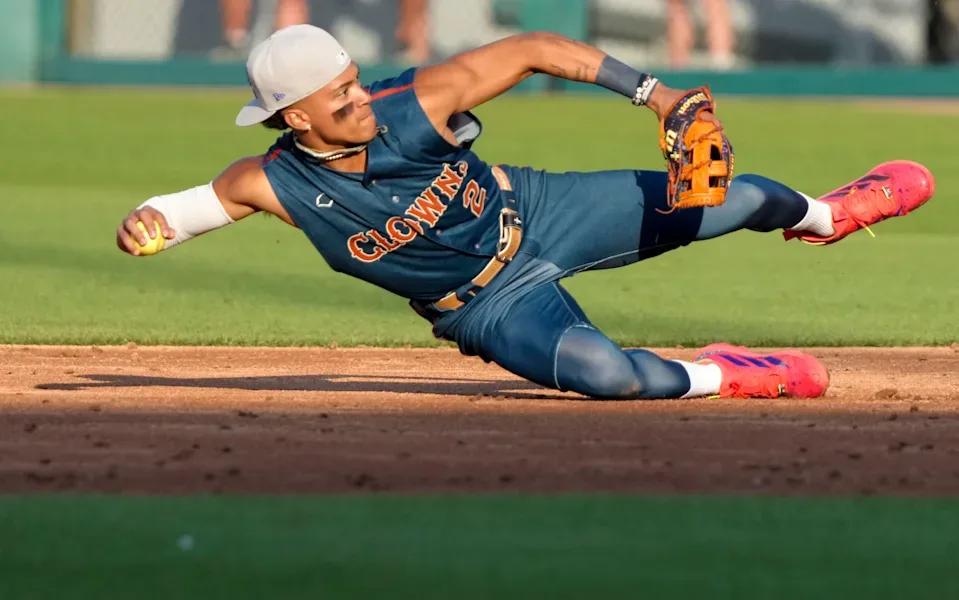
Those are tactical conclusions, not added laws. The Boston Globe reported that practiced Bananas defenders had developed the play enough to limit many opponents’ advancement, but one report cannot guarantee the result of the next sprint. A different starting location, a rushed throw, a faster hitter, or a recovery mistake can change the race. Judge execution one play at a time.
Runner Strategy: When to Take Another Base
The official permission is broad: the hitter can advance to as many bases as desired. The outcome is not. “Can try for third” does not mean “is awarded third,” and it certainly does not make every Ball Four Sprint a home run. The runner must turn a temporary protected window into actual safe advancement before the defense completes its requirement and makes the live play.
A sensible runner is processing several signals at once:
- Where ball four finished: a ball already near a well-positioned defender may begin a cleaner sequence than one that sends the catcher scrambling.
- How far the defense has progressed: another base is more attractive early in the touch process than when only the final participation appears to remain.
- Transfer quality: a bobble, offline exchange, or retrieval can buy time; a chain of controlled short transfers closes the window.
- The runner’s speed and turns: a fast straight line does not help if a wide turn adds distance or destroys the option to stop safely.
- Game context: outs, inning score, and whether the game has reached its last inning can change the value of risk.
The last factor requires points awareness. In an ordinary Banana Ball inning, the team with more runs earns the inning’s point. In the last inning, every run counts as a point. A risky attempt that might create a decisive run can therefore look different from the same attempt in a less urgent situation. This is strategic interpretation, not a rule commanding the hitter to be aggressive at a particular score.
Evaluate the decision at the moment it was made. A runner who stops at second after reading a flawless defense did not necessarily lack ambition; the stop may preserve a valuable baserunner. A runner thrown out trying for third may still have responded reasonably to an exchange that initially looked broken. Results reveal what happened, not every piece of information available during the turn.
Use the displayed game record and our Banana Ball scores to see whether the play produced a run and how the inning affected the points result. Do not infer unlisted rights for runners who were already on base from advice aimed at the hitter. That remains an officiating/rulebook question the public Rule 6 paragraph does not fully answer.
Ball Four Sprint vs Stealing First
Both rules can send a hitter racing toward first without putting a batted ball into fair territory, but their triggers are not interchangeable. The Ball Four Sprint waits for the count to reach four balls. Stealing first can be attempted on any pitch of the at-bat when a passed ball or wild pitch creates the opportunity.
| Question | Ball Four Sprint | Steal first |
|---|---|---|
| What starts it? | The umpire calls ball four. | The hitter reacts to a pitch getting away, such as a passed ball or wild pitch, on any pitch of the at-bat. |
| Does the plate appearance need a four-ball count? | Yes. | No. |
| What special defensive condition is published? | The required defenders must touch the ball before it becomes live; pitcher and catcher need not touch it. | Official Rule 5 announces the hitter’s opportunity but does not repeat Rule 6’s all-defender touch condition. |
| What should a viewer watch? | The count, hitter’s launch, defensive touches, and live-ball transition. | The pitch escaping the catcher and the hitter’s immediate decision to run. |
The passed-ball/wild-pitch labels describe why the catcher did not control the pitch. In conventional scoring, a passed ball is generally charged when the catcher should have handled the pitch with ordinary effort, while a wild pitch is charged to the pitcher for a pitch too errant to control. The official scorer makes that distinction. For understanding Banana Ball in real time, the more urgent fact is that the ball got away and the hitter may try for first.
Do not automatically apply the Ball Four Sprint’s protected touch window to steal first. The public Rule 5 description does not state that condition. Likewise, do not call every Ball Four Sprint “stealing first”; it is the formal consequence of reaching ball four and permits the hitter to consider advancement beyond first. Listen to the count, then look at what happened to the pitch.
Ball Four Works Differently in a Showdown
Reset your Rule 6 mental model when a Showdown begins. The current official Showdown section uses “ball-four sprint” terminology, but its result is a runner-placement and count-reset procedure. It is not presented as the standard race in which the full set of eligible fielders completes touches while the hitter circles the bases.
The shared Showdown framework is this: after four balls, a runner is placed at second. The batter who earned the ball-four result may stay at the plate with the count reset, although the manager may choose another batter and designate the team’s runner. Runners may not take leads, and they may not advance on wild pitches or passed balls. The round-specific provisions then determine how placed runners become points.
Rounds 1 and 2
- After the first ball-four result, a runner is placed at second. If the continuing or replacement batter puts the ball in play and scores that runner, the team earns the one point available in the round and the round ends.
- If the plate appearance produces a second ball-four result instead, the runner advances from second to third and the batter may continue again with a reset count.
- A third ball-four result scores the runner from third. That supplies the one point needed, so the round ends.
The official high-value example for Rounds 3 and 4
- On the first ball-four result, the official page says runners are placed at second and third and two runners score. If the batter then puts the ball in play and scores both remaining runners, the team reaches the four points allowed in the round.
- On a second ball-four result, the runner from second moves to third and the runner who was at third scores. The batter may continue with another reset count.
- On a third ball-four result, the remaining runner at third scores, bringing the team to the four-point round limit.
This is why a casual phrase such as “ball four always starts the all-fielders relay” is unsafe. It describes the normal-game signature play but not the official Showdown placements. It is equally unsafe to import ordinary wild-pitch running: the Showdown rule expressly bars placed runners from leading or advancing on wild pitches and passed balls.
Before interpreting the call, identify whether you are in regular play or a Showdown, then identify the round. The official page’s detailed examples are the controlling reference for placements and scoring. If a future revision changes the high-value rounds or continuation language, use the updated official page rather than an old video caption or remembered sequence.
How to Read the Play Live Without Guessing
- Check the game phase. A normal inning uses Rule 6’s running-and-touches play; a Showdown uses its placement and count-reset provisions.
- Confirm the count. The signature sprint begins on ball four, not merely because a pitch escaped the catcher.
- Follow the hitter and the ball separately. The hitter is deciding how far to advance while the eligible defenders complete their participation.
- Wait for the live transition. Do not call an early tag-out before the required touches; follow the umpire’s administration rather than guessing the final touch from a distant seat.
- Record the result, not an assumption. The hitter might stop safely, take multiple bases, score, or be retired after live play begins. None is guaranteed by the trigger alone.
The best way to make that sequence intuitive is to watch authentic examples on our Banana Ball videos page, then use Banana Ball games today to follow a current matchup. Compare what you see with the current official rule, because old clips may use a prior operational version and captions often compress the details.
Is ball four still a walk?
It begins with the familiar four-ball count, but it does not award an ordinary walk to first. In standard Banana Ball play, ball four triggers the hitter’s sprint and the defense’s touch requirement. In a Showdown, it triggers the separate placement/reset procedure described above.
Must all nine defenders touch the ball?
No. The official page explicitly says the ball does not have to touch the pitcher or catcher. It requires the other defensive participation before live play, without publishing a fixed order on the public page.
Can the hitter be tagged immediately?
Not before the required defensive touches are complete. CBS’s explanation says the hitter cannot be tagged out during that protected phase. After the ball becomes live, the defense can retire the advancing hitter, so the protection is temporary.
Does a Ball Four Sprint guarantee a home run?
No. The hitter is permitted to try for as many bases as desired, but the defense is racing to activate live play and stop the advance. Reported games show practiced defenses can limit runners, while a poor exchange can create more opportunity. Treat every base beyond the runner’s safe position as a decision, not an award.
Comments
Comments are reviewed before publication. Spam, personal information and abusive content are not published.
Loading comments…