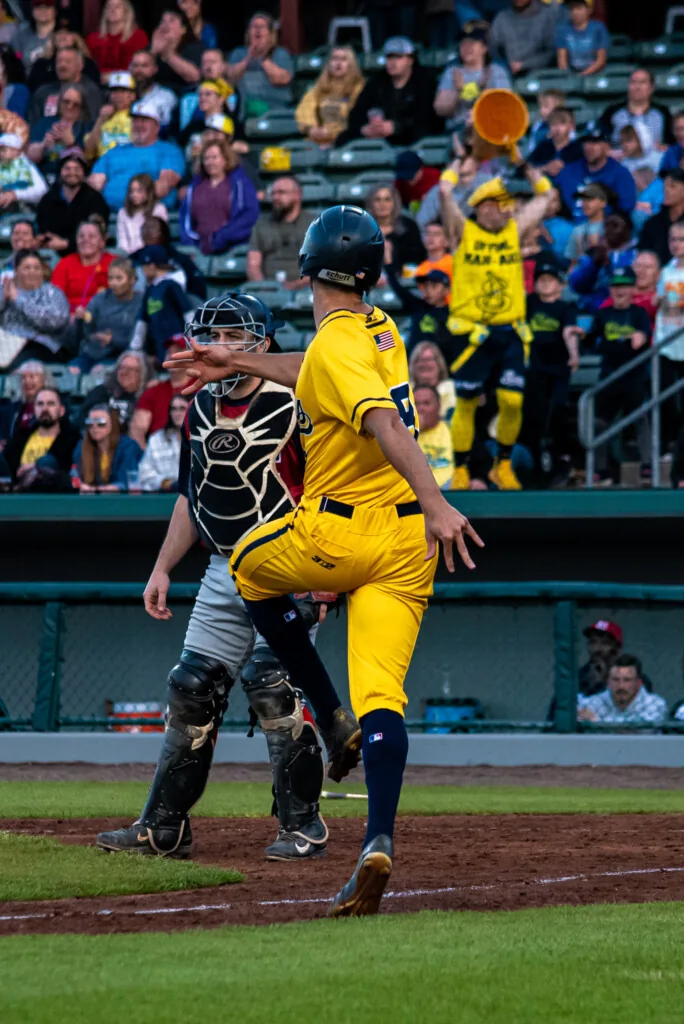
Banana Ball keeps the recognizable contest between pitcher, hitter, fielders, and runners, but it changes how that contest is timed, scored, and finished. A traditional professional baseball game is decided by total runs across a nine-inning framework. Banana Ball awards points for winning innings, stops starting new innings after two hours, turns ball four into a sprint, and can send a tie to a stripped-down Showdown. It also gives spectators a direct role when they cleanly catch a foul ball. The easiest way to follow your first game is to separate the familiar baseball action inside a play from the Banana Ball rules that determine what that play is worth. This guide compares the current official formats side by side and flags the differences that most often confuse new viewers.
Banana Ball vs Baseball at a Glance
“Baseball” in this comparison means the professional game described by Major League Baseball’s official rules and glossary. College, high-school, youth, and local leagues can have their own variations. Banana Ball is not simply an MLB game played faster: its points system, game clock, fan-catch out, challenge format, and Showdown create a different competitive framework.
| Situation | Banana Ball | Traditional professional baseball |
|---|---|---|
| How the winner is measured | Points decide the result. Most innings are worth one point to the team that scores more runs in that inning; every run counts in the last inning. | Total runs accumulated over the whole game decide the result. |
| Normal game framework | No new inning may start after two hours. An inning already underway still has to reach its proper ending. | A regulation game normally gives the trailing team the opportunity to make 27 outs across nine innings, subject to official shortening or suspension rules. |
| Ball four | The hitter begins a Ball Four Sprint and may try to advance while the defense completes the required touches. | The batter is awarded first base on a walk, recorded as BB. |
| Batter pace | Stepping out of the box produces a strike. | MLB uses batter-readiness and pitch-timer rules, with its own violations and exceptions. |
| Bunting | A hitter who bunts is ejected. | A legal bunt remains a permitted offensive play. |
| Mound conferences | Coach, catcher, and player mound visits are not allowed. | Limited, timed mound visits are permitted, with defined exceptions. |
| Foul ball caught by a spectator | A clean fan catch records an out. | A ball that reaches the stands is ordinarily out of play; a spectator does not become a fielder. |
| Tie after the main game | A tie at the end of the two-hour limit goes to a Showdown Tiebreaker. | A tie after nine innings proceeds to extra innings under the applicable competition rules. |
The table is a starting map, not a replacement for the rulebook. Keep the core distinction in mind: a familiar-looking hit, out, or run can have a different strategic value because Banana Ball packages those events into inning points. For a rule-by-rule treatment, open our complete Banana Ball rules explainer alongside the game.
Points, Runs, and How a Winner Is Decided
Runs still happen in Banana Ball. A runner advances around the bases and reaches home just as the basic baseball action suggests. The difference is what happens next on the scoreboard. Under official Banana Ball Rule 1, the team with more runs in an inning receives one point for that inning. A 1-0 inning and a 6-0 inning are therefore each normally worth one point. The six runs may reveal a dominant offensive frame, but they do not turn that ordinary inning into six points.
Traditional professional baseball carries every run into one cumulative game total. If one team scores six in the first inning and the other scores one in each of the next five, the game is tied 6-6. Under Banana Ball’s inning-point concept, that same hypothetical distribution would give the first team one point and the other team five points. The example is intentionally simplified, but it shows why adding the runs from a Banana Ball line score can produce the wrong answer to “Who won?”
The last inning is the important exception. The official rule says that every run counts in the last inning. That creates room for a late points swing instead of making the final frame just another single-point contest. Viewers should watch for which inning has been designated as the last under the clock and game situation; they should not assume the ninth is automatically the final inning.
When checking a completed game, begin with the points result on our Banana Ball scores page. Then look at runs and inning details to understand how those points were produced. The BBCL standings use the game outcomes, so confusing runs with points can also distort your impression of the league race. The short version is simple: runs win the inning; points win the Banana Ball game. In conventional baseball, runs themselves remain the game-winning total.
Two Hours Instead of a Fixed Nine-Inning Target
Banana Ball’s clock controls when another inning may begin. Current official Rule 2 says that no new inning can start after two hours. It does not say that an umpire freezes the action at exactly 2:00 with a pitch in flight or an unresolved half-inning. In practical terms, the teams play the active inning to its required conclusion, and the clock tells them whether another one can start. If the points are tied at the end of the time-limited portion, the official Showdown rule supplies the tiebreaker.
That is different from saying every game lasts exactly 120 minutes. A late inning can carry the event past the clock, and a Showdown can add more time. The number of completed innings can also vary with the pace of play. For travel planning, treat two hours as the design target and inning-start cutoff, then leave a buffer rather than scheduling a train, parking exit, or livestream switch for the exact two-hour mark.
MLB’s normal framework is based on outs and innings rather than a whole-game clock. An unshortened regulation game normally gives the trailing team an opportunity to make 27 outs across nine innings. If the home team is already ahead after the top of the ninth, it does not need to bat again. Weather, suspensions, and other official provisions can alter that framework, but there is no Banana Ball-style rule that simply bars the next inning because two elapsed hours have passed.
Be careful with older explainers. A 2022 Los Angeles Times feature described a no-new-inning point at one hour and 50 minutes. That was useful reporting on the format at the time, but it does not override the current official page, which says two hours. Rule details evolve, and search snippets can outlive the version they described. Before attending or watching, confirm the day’s matchup on Banana Ball games today; use the official rules page for the current clock language.
At the Plate, Banana Ball Removes Familiar Pauses
Three headline rules attack downtime directly. First, a Banana Ball hitter who steps out of the batter’s box receives a strike. Second, a hitter who bunts is ejected. Third, a coach, catcher, or other player may not visit the mound. Together, these rules remove familiar reset buttons: the batter cannot routinely walk away to reorganize, the offense cannot trade an out for a softly placed sacrifice, and the defense cannot gather around the pitcher to interrupt an inning.
MLB has also adopted pace controls, so “baseball has no clock” is too broad. Its pitch-timer rules require a batter to be in the box and alert by a specified point, and a violation can cause an automatic strike. MLB’s batter’s-box rules also contain situations in which a hitter may leave or request time. Banana Ball’s public rule is much more direct for the viewer: if the hitter steps out, it is a strike. Watch the umpire rather than assuming every step away is a harmless routine.
The tactical difference on a bunt is just as sharp. In conventional baseball, a sacrifice bunt can deliberately advance a runner while conceding an out, and an attempted bunt for a hit can reward placement and speed. Banana Ball rejects that tradeoff with ejection. A hitter must instead create action through a swing, while the defense can prepare for a narrower set of contact choices. That does not make strategy disappear; it moves strategy toward swing selection, running pressure, and the special lineup tools available elsewhere in the format.
Mound visits show the same design choice. MLB permits a limited number of timed conferences and lists exceptions, including potential injury situations. Banana Ball’s headline rule bars the coach, catcher, and other players from visiting the mound. Do not expand that sentence into an unsupported claim that officials can never stop play for safety. The useful viewing takeaway is narrower: ordinary strategic conferences are not part of the rhythm, so the pitcher and defense must recover without the familiar huddle.
Finally, keep “steal first” separate from ball four. Official Banana Ball Rule 5 says the hitter may try to steal first on any pitch of an at-bat when a passed ball or wild pitch creates the opportunity. The Ball Four Sprint begins because the count reaches four balls. Both create sudden running, but they have different triggers. Staying focused on the catcher and the count will tell you which rule you are seeing.
Ball Four Becomes a Race, Not a Free Base
In MLB, four balls produce a base on balls: the batter is awarded first base and the scorebook records BB. Forced runners advance as required by baseball’s walk rules, but the batter does not have to outrun a relay simply to claim that award. Banana Ball replaces that pause with one of its signature action sequences.
- The umpire calls ball four. The hitter immediately takes off rather than jogging to an awarded first base.
- The hitter chooses how far to push. The current official rule allows the hitter to advance to as many bases as desired during the sprint.
- The defense completes its touch requirement. Every required defensive player must touch the ball before it becomes live. The official page specifically says the ball does not have to touch the catcher or pitcher.
- Live play resumes. The defense can then try to stop the advance, so the runner must judge whether another base is worth the risk.
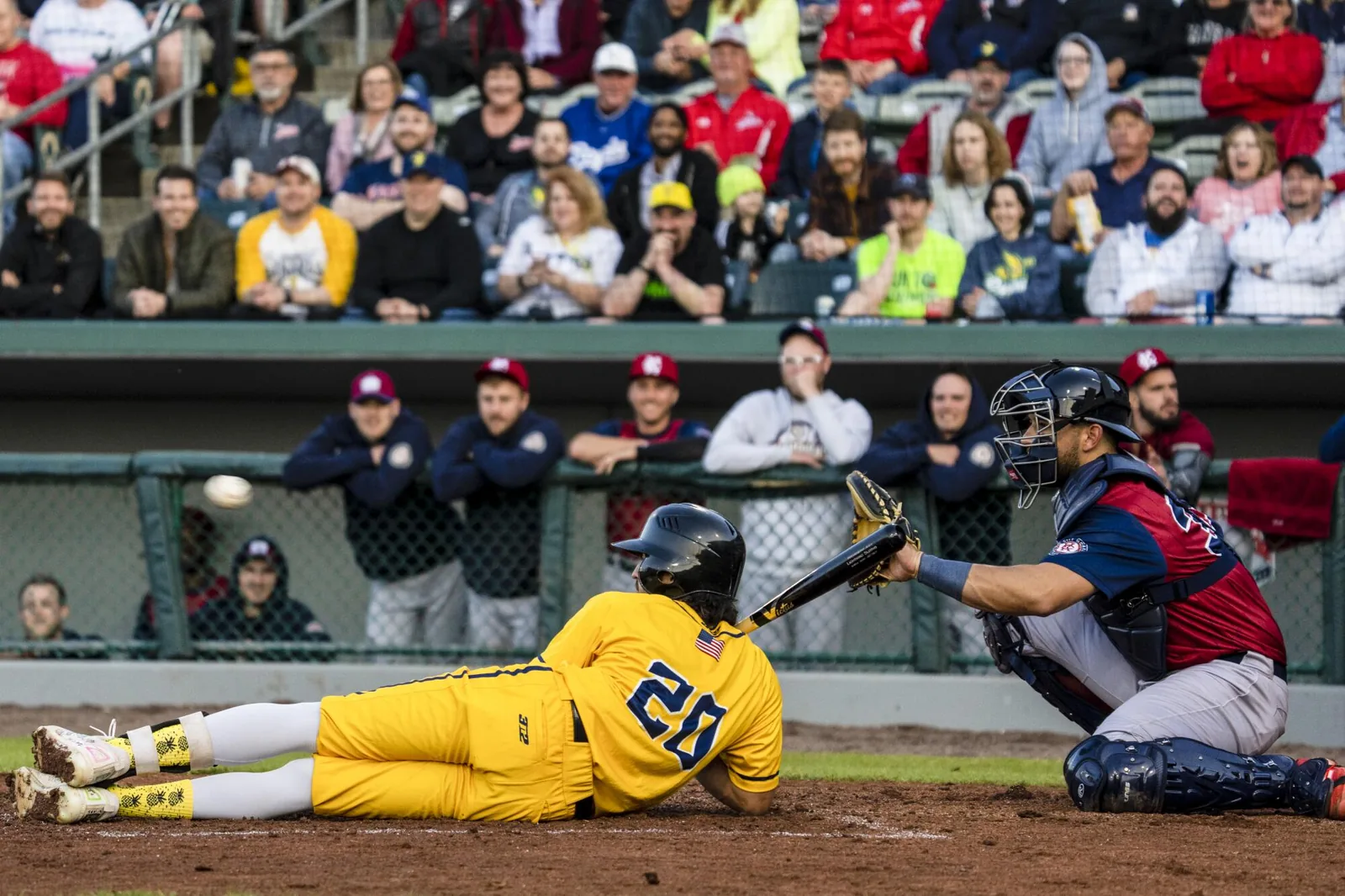
The public official rule does not specify a mandatory order in which the eligible fielders must touch the ball. A smooth defense will naturally value quick, accurate exchanges and useful positioning, but that is a tactical inference, not an extra sequence readers should mistake for rule text. Likewise, this guide does not invent rights for runners who were already on base. The controlling rule paragraph describes the hitter’s sprint; unusual runner or ball-status situations belong to the umpires and the current operating rules.
For the hitter, the essential decision is aggressive but not mindless. One extra base can create a scoring opportunity, while pushing after the defense has nearly completed its work can turn the advantage into an out. For the defense, a wild throw can cost more time than a conservative transfer. Those incentives make ball four visually and strategically different even though the plate appearance still began with the familiar battle over the strike zone.
When watching live, do not look away when the count reaches three balls. Follow the hitter, count the defensive involvement without assuming a prescribed order, and wait for the play to become live. You can use our Banana Ball videos page to find real game clips and practice recognizing the sequence. Remember that a passed ball or wild pitch earlier in the at-bat may instead trigger the separate steal-first rule.
Fans, Challenges, and Showdowns Change Who Matters
Banana Ball turns a spectator into part of one specific defensive outcome. If a fan cleanly catches a foul ball, the hitter is out. The catch cannot bobble or juggle. That is not the same as a spectator reaching into the field, and it does not mean any souvenir ends the game. It records one out, which would end the game only if that out also happens to complete the decisive situation.
Traditional baseball draws a stronger boundary around the field. MLB’s spectator-interference guidance says no interference is called merely because someone in the stands contacts a ball without reaching onto the field, even if a fielder might otherwise have caught it. If the spectator clearly reaches into play and prevents a catch, umpires can declare interference and impose the appropriate placement or out. The fan is never simply credited as another legal outfielder.
Banana Ball also gives the crowd a voice in replay. Each team has one challenge to a ruling and must launch its challenge prop before the next pitch. If the review overturns the call, the team retains its challenge; an upheld or inconclusive review costs the team that opportunity for the rest of the game. The public rule lists fair/foul calls, force/tag plays, infield or outfield catches, and missed bases as challenge categories. Separately, the fans choose a representative who has one fan-challenge opportunity during the game.
MLB has manager challenges and crew-chief review, but not a crowd-selected representative with an independent challenge prop. Its replay officials examine defined reviewable categories and can confirm, change, or let a call stand. The shared idea is correcting eligible calls through video; the visible participants and procedure differ.
The tie procedure creates an even larger departure. MLB normally continues a tie after nine innings with extra innings. Banana Ball moves a tie at the end of the two-hour portion into a Showdown. Officially, round one puts a pitcher, catcher, and one fielder against one hitter. Round two removes that extra fielder. Round three restores one fielder and begins with the bases loaded; later rounds continue under the detailed official Showdown provisions until there is a winner.
A home run over the outfield wall at any point in a Showdown is an immediate walk-off win. Otherwise, the round-specific point caps and ball-four procedures matter, so a Showdown should not be summarized as “ordinary extra innings with fewer players.” For your first game, focus on the essential objective: the hitter must score against the reduced defense, while an out produces a “Showdown Shutdown.” The official rules page should settle the more detailed branches.
For live attendance, stay in your seating area and follow the venue’s safety policies. A glove can be useful in exposed foul territory, but the rule is never permission to lean into the field, obstruct another spectator, or ignore protective netting. Make the clean catch if the ball safely reaches you, then wait for the umpire to signal the out.
Which Rules Should a First-Time Viewer Learn First?
- Read points before total runs. Runs decide who wins an ordinary inning; the resulting points decide the game. Every run becomes a point in the last inning.
- Watch the clock and inning designation. Two hours stops a new inning from starting, not an active play in midstream.
- Do not relax on ball four. It starts a sprint. A passed ball or wild pitch can separately let the hitter try to steal first on any pitch of the at-bat.
- Expect penalties that protect pace. Stepping out brings a strike, bunting brings ejection, and ordinary mound visits are barred.
- Keep the crowd and tiebreaker in view. A clean fan foul catch is an out, fans have a separate challenge opportunity through their representative, and a tied timed game goes to a Showdown.
You do not need to memorize every Showdown branch or lineup exception before first pitch. Open today’s Banana Ball games, keep our points-first scores available, and consult the full rules explainer when an unusual call appears. Once the five ideas above are familiar, the traditional-looking pitches and batted balls become much easier to place inside the new format.
Is Banana Ball still baseball?
It uses baseball’s diamond, bases, pitching, hitting, fielding, outs, and runs, but it operates under a distinct competitive rule set. CBS’s reporting captures the useful distinction: the entertainment presentation may be planned, while the game itself is real competition. Calling it either ordinary MLB baseball or merely a scripted show misses half of the picture.
Can a Banana Ball game go longer than two hours?
Yes. The official rule says no new inning starts after two hours; it does not promise that all action ends at exactly two hours. The inning in progress needs resolution, and a tied game may require a Showdown. Plan for a variable finish.
Do runs still matter in Banana Ball?
Absolutely. Runs determine which team wins an ordinary inning, and every run counts as a point in the last inning. They also remain meaningful player and team statistics. The distinction is that the official game result is expressed in points, so cumulative runs alone cannot tell you the winner.
Comments
Comments are reviewed before publication. Spam, personal information and abusive content are not published.
Loading comments…