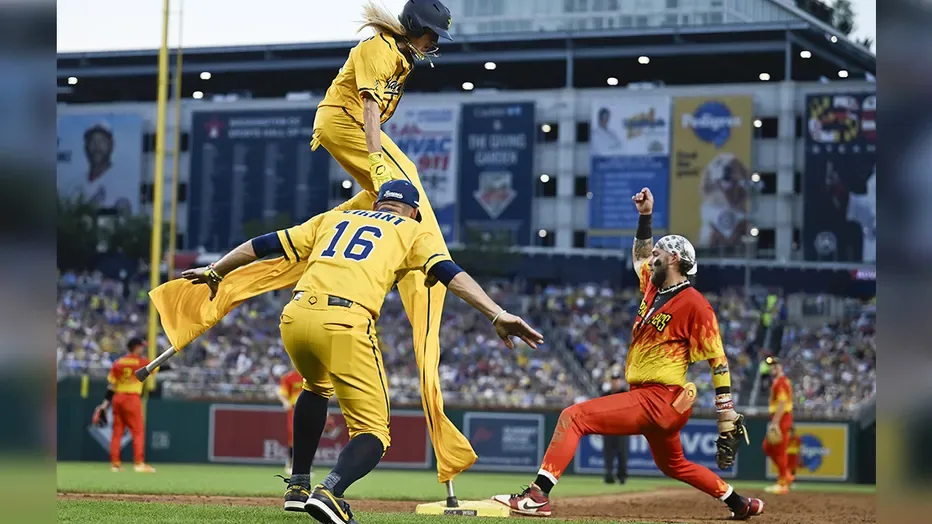
A Banana Ball trick play is more than a difficult catch or a flourish for the crowd. In practical scoring terms, look for a normally routine defensive play completed in a deliberately non-routine way, with an out recorded. The distinction matters because trick plays are tracked in game totals and, under the rule explanation reviewed on August 19, 2026, can earn the visiting team an Equalizer Point before the final inning. That does not mean every behind-the-back attempt, trick pitch, dance, or stylish throw automatically counts. The public 11-rule summary is not a complete scorer's manual, so fans should separate what the broadcast or official box score credits from what merely looks spectacular on a clip. This guide explains that boundary, the Equalizer, and the fastest way to read the stat without confusing it with the final score.
What counts as a Banana Ball trick play?
The most useful working definition is simple: a defender turns a play that would normally be routine into a deliberately non-routine action, and the sequence still produces an out. That last condition is essential. A ball flipped behind the back but dropped at first may be an ambitious trick-play attempt; it is not the same as a recorded trick-play out. Likewise, an outstanding diving catch can be difficult without necessarily being non-routine in the particular way Banana Ball scorers recognize.
Use this four-question test while watching:
- Was the ball live? The action should belong to the competitive play, not a between-pitch routine or celebration.
- Was the execution intentionally non-routine? Look for an unusual catch, transfer, toss, throw, or qualifying pitch action rather than ordinary sound defense.
- Did the defense complete an out? If no out follows, do not add a trick play to your own count.
- Was it officially credited? The broadcast call and finalized game totals are the practical authority when a borderline sequence is unclear.
The test explains why trick plays are not a separate exhibition layered on top of the game. They happen inside real defensive sequences, and any position can participate. Ground-ball relays, airborne catches, and strikeout-related actions have all appeared in reported examples. Yet the public-facing Banana Ball rules guide is a summary, not a complete scorer handbook with every approved variation. Fans should therefore avoid declaring an exhaustive list or awarding an unofficial count from a short video. Use the definition to understand the play, then use the stats guide and completed game record to confirm what was actually credited.
Trick play, trick pitch, and showmanship are not the same thing
Banana Ball places competition and entertainment in the same frame, but its recorded categories should not be collapsed into one. Current game broadcasts label trick plays separately from dances and celebrations. They can also describe a normal defensive out without crediting a trick play. The question is not simply, “Did this look fun?” It is, “Did a non-routine technique become part of a completed competitive out?”
| What you see | What it means | Automatic trick-play credit? |
|---|---|---|
| Defensive trick play | An unusual catch, transfer, or throw is used to finish an out. | No; wait for the out and the official credit. |
| Trick pitch | The pitcher uses a non-routine motion or delivery during a live at-bat. | No; a memorable pitch by itself is not enough to assume a recorded trick-play out. |
| Dance or celebration | Players perform before, between, or after competitive action. | No; broadcasts categorize these moments separately. |
| Difficult ordinary play | A defender makes an athletic dive, leap, or long throw using conventional technique. | Not necessarily; difficulty and trick-play style are different tests. |
A trick pitch can be connected to trick-play credit when it produces the qualifying out, and 2026 broadcasts have paired trick-play language with strikeouts. That still does not justify counting every behind-the-back delivery thrown earlier in an at-bat. Public materials reviewed for this guide do not expose the full pitch-by-pitch scorer procedure, so the safe approach is to watch the completed plate appearance and then check the official call. This also prevents a second common mistake: treating rehearsed showmanship as fake competition. The dancing can be planned while the ball-in-play outcome remains real. Use the site's verified Banana Ball videos to compare timestamped trick plays with separately labeled celebrations.
Common types of trick plays to watch for
There is no public, exhaustive menu that turns each move into guaranteed credit. Still, live broadcasts and documented player examples reveal several recurring families. Learn these patterns as viewing cues, then wait for the play to end and the scorer or announcer to confirm it.
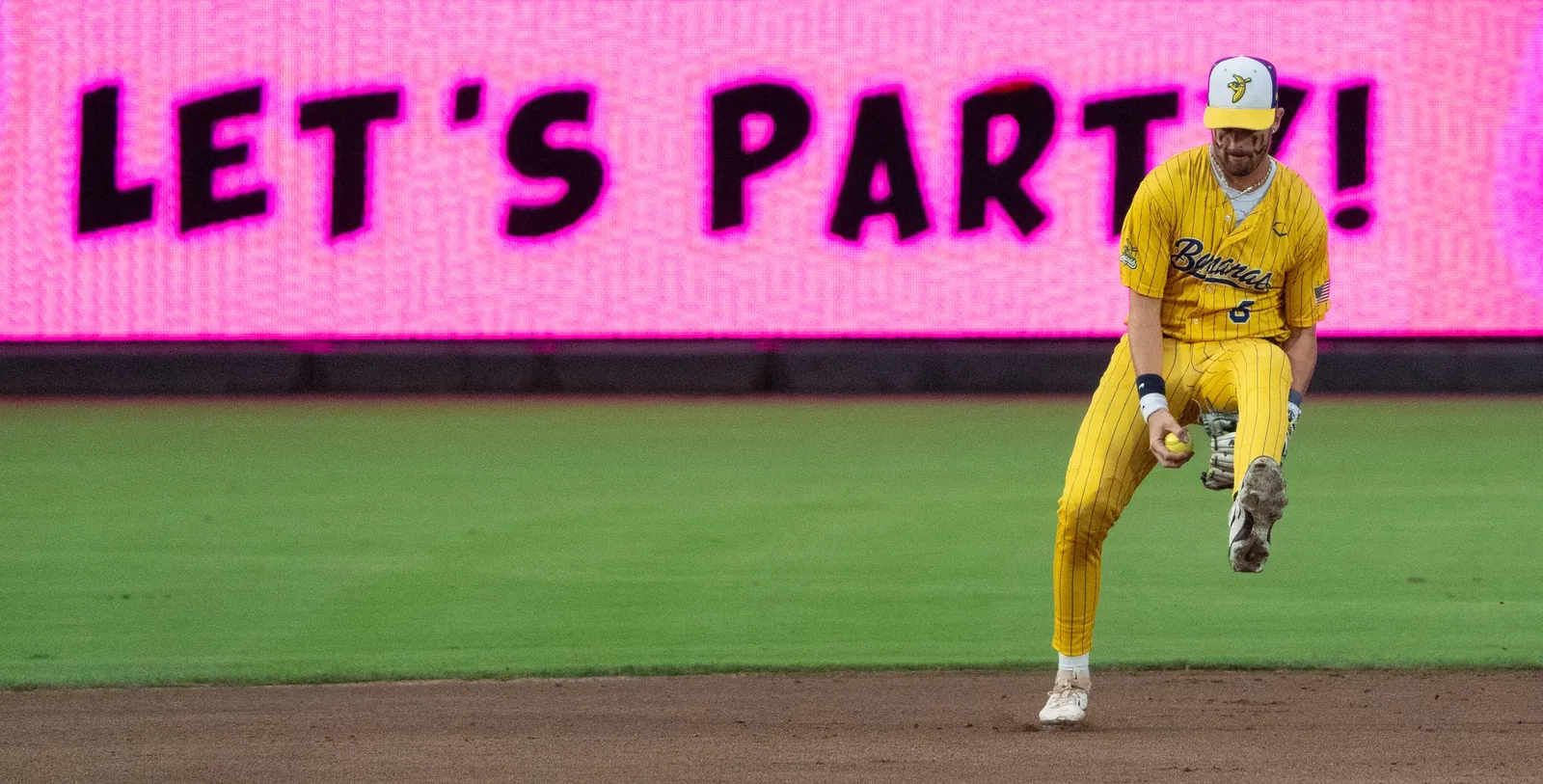
- Behind-the-body and between-the-legs throws: an infielder fields a routine grounder, redirects the ball around or under the body, and still beats the runner. Ryan Cox's documented under-the-leg throw is a clear visual example of this family.
- Tip drills: a fielder intentionally knocks a catchable ball upward before completing the catch or sending it to a teammate. Timing matters because the defense still needs the out; a dropped finish changes the result.
- Glove flips, tosses, and unusual transfers: the defender moves the live ball without a standard hand-to-glove-to-throw sequence. Mid-air glove tosses and no-look transfers can belong here.
- Unusual catches: broadcasts and reporting have shown behind-the-back, between-the-legs, barehanded, and acrobatic catches. A backflip is visually obvious, but the catch must survive the landing and record the out.
- Trick-pitch strikeouts: pitchers may use unconventional deliveries, and broadcasts have credited trick-play outs with strikeouts. The completed strikeout is the key observation; do not tally every unusual pitch in the plate appearance.
Combinations can involve more than one defender, and announcers sometimes call a sequence a “double trick play.” That label does not give spectators a universal formula for allocating individual credits. Watch the entire chain: initial touch, transfer, catch or throw, base contact, and umpire's out call. Then compare the broadcast with the finalized Banana Ball scores and game totals. If you want the actual moving sequence rather than a text description, use the verified video hub and select a timestamp labeled Trick Play.
How the Trick Play Equalizer Point works
As verified on August 19, 2026, the Equalizer is a specific one-point opportunity for the visiting team. At the moment the game moves into its final inning, compare the credited trick-play totals. If the visitor has strictly more than the home team, one point is added to the visitor's score. The word “more” matters: an equal count does not earn the point, and a home-team lead does not produce a matching bonus for the host.
| Entering the final inning | Equalizer result | Reason |
|---|---|---|
| Visitor 9, home 8 | Visitor gains 1 point | The visitor is ahead in qualifying trick plays. |
| Visitor 9, home 9 | No Equalizer | A tie is not “more.” |
| Visitor 8, home 9 | No Equalizer | The visitor is behind. |
| Visitor 0, home 0 | No Equalizer | Neither side has a strict advantage. |
Think of the rule as a checkpoint, not a running style score. Trick plays are accumulated and shown as game statistics during the earlier action; the relevant comparison is made before the final inning. Announcers may discuss the margin throughout the game because each completed out can move that race. Once the final inning begins, every run counts as a point under the current scoring format. A later trick play may still complete an important out, but it does not go backward in time and change the already determined Equalizer comparison.
The extra point also does not replace ordinary scoring. In most innings, the team with more runs wins the inning's point. The Equalizer is then added only if its visitor-side condition is met, and final-inning runs can still change the game. That is why a broadcast may call a single trick-play margin pivotal without saying trick plays are the whole scoreboard. Review the complete rules explanation, then use the final scores rather than reconstructing a winner from one statistic.
How to read trick plays in a Banana Ball box score
Start at the top, not at the most unusual number. A completed game page should identify the game as final and display each team's point score. That is the official result. Runs, hits, and trick plays explain parts of how the contest developed, but none of those columns can independently replace points.
- Confirm the status. A live or partially updated page can change; use a record marked final before drawing conclusions.
- Read points first. The larger final point total identifies the winner.
- Read runs and inning detail next. These show how teams won normal innings and scored in the final inning when that detail is available.
- Use trick plays as context. Compare the totals to understand the Equalizer race and defensive style, then consult video or player data for individual examples.
The July 2, 2026 Party Animals–Texas Tailgaters page demonstrates the distinction neatly. Its stored final shows a 4–1 Party Animals win in points, while the displayed game totals list four Party Animals trick plays and 11 for Texas. The larger trick-play number did not turn into the larger final score. It was one competitive input within a format also shaped by inning wins, the Equalizer's visitor-only condition, and final-inning runs.
Availability can vary by game. A page may have the final score and team totals before its inning-by-inning line or player statistics are complete. Treat a missing detail as pending, not zero, and do not manufacture individual credits by dividing the team total. The quickest workflow is to open completed scores, inspect the game record, then check current standings for season position. For definitions and data-status labels, keep the Banana Ball stats guide beside the box score.
What does not count, and where judgment remains
The completed-out requirement removes many apparent examples immediately. A dropped behind-the-back catch, an off-target glove flip that lets everyone reach safely, or a flourish after the umpire has called time does not satisfy the basic test. But do not stop watching at the first bobble. A 2026 broadcast described a missed tip attempt followed by a recovery that still produced a credited trick-play out. The scorer evaluates the completed live sequence, not a frozen screenshot.
| Viewer category | Examples | Best action |
|---|---|---|
| Counts when credited | Non-routine live-ball technique that ends in a recorded out | Confirm the broadcast call or finalized total. |
| Probably not | Failed attempt with no later out, dance, celebration, dead-ball flourish, or conventional play that is merely difficult | Do not add it to a fan tally. |
| Wait for the scorer | Multi-player tip sequences, several unusual touches on one out, and the exact treatment of trick pitches within an at-bat | Avoid assigning a number from appearance alone. |
Multiple touches create the hardest ambiguity. Broadcasts can call a “double trick play,” yet that does not publish a universal rule that every clever touch equals one individual credit. The same caution applies to pitching. A trick delivery and a strikeout may be associated with credited trick-play language, but public summaries reviewed here do not explain every pitch-count edge case. Community answers are useful evidence that fans share the question; they are not a substitute for an official scorer note.
If your manual count disagrees with the displayed team total, preserve the official number and label your clip observation as unofficial. A camera angle can hide a touch, a replay can omit the end of the play, and a highlight title may favor excitement over scoring precision. The stats guide explains the same evidence hierarchy: finalized data first, verified video for context, and inference clearly separated from both.
Why teams attempt trick plays even when they are risky
The first reward is still the ordinary baseball out. A successful under-the-leg throw retires a runner before it becomes a statistic or a highlight. The Equalizer adds a second incentive: the visiting team can turn a strict trick-play advantage into one point entering the final inning. The home team cannot earn that visitor-only bonus, but each credited home trick play raises the total the visitor must beat. Both defenses therefore have a competitive reason to execute, not merely perform.
The risk is equally real. An extra flip takes time, an unusual grip can reduce accuracy, and a tip drill can turn a catchable ball into a live mistake. In a July 2026 recap, a missed trick-play attempt with a runner on third led to a run. That run could affect an inning point before anyone reaches the Equalizer checkpoint. Players reduce the danger through repetition: reported practices combine conventional ground balls, fly balls, and defensive work with deliberate trick-play training.
A smart attempt usually answers three questions:
- Is the play routine enough that the defender has time and body control?
- Where are the runners, and what damage follows if the ball gets away?
- Does the team need to press the trick-play margin, or is the sure out more valuable now?
This tradeoff is why the best clips feel tense. The players are competing, and the result is not scripted even when surrounding dances are choreographed. A club's style may make certain moves more common, so browse the current Banana Ball teams to learn the personnel. Then check the standings instead of assuming the most theatrical team automatically owns the best record. Entertainment value and competitive success can reinforce each other, but neither guarantees the other.
Banana Ball trick play rules FAQ and viewing checklist
| Question | Short answer |
|---|---|
| Is there an official trick-play rules PDF? | The official one-sheet PDF lists the 11 headline Banana Ball rules, but it is not a complete trick-play scorer's manual and does not catalogue every move or edge case. |
| Does every trick play score a point? | No. Trick plays are recorded statistics and can collectively affect the visitor's one Equalizer Point. A single credited trick play is not automatically one point. |
| Does a failed trick-play attempt count? | Not by itself. The practical definition requires a completed out. Keep watching if the defense recovers and finishes the live sequence. |
| Can several players earn credit on one out? | Broadcasts do identify double trick plays, so multi-player combinations exist. Do not assume a universal one-credit-per-touch formula; confirm the official call and totals. |
| Is this the same as an MLB trick play? | No. Conventional baseball can feature deception or unusual defense, but MLB does not use Banana Ball's tracked trick-play category and visitor Equalizer mechanic. |
For a live game, use this five-step checklist:
- Locate the ball and confirm the action occurs during live play.
- Identify the non-routine move—catch, tip, transfer, throw, or pitch action.
- Wait for the out call instead of celebrating the attempt too early.
- Listen for official credit and note whether the announcer calls one, double, or no trick play.
- Verify the final record on the scores page, keeping points separate from runs, hits, and trick plays.
The core idea is easy even when an edge case is not: non-routine execution must survive real competitive consequences. For the surrounding scoring system, read the complete rules guide; for the contrast with traditional baseball, use the Banana Ball versus baseball comparison. Rules can evolve, so this explanation reflects sources and games checked through August 19, 2026. If a future first-party scorer guide publishes a more precise trick-pitch or multi-touch rule, that newer document should control.
Comments
Comments are reviewed before publication. Spam, personal information and abusive content are not published.
Loading comments…