Yes, a Banana Ball game can go past two hours. The official rule prevents a new inning from starting after two hours. Play can continue to finish the game, and a tie in points sends the teams to a Showdown instead of another regular inning. The final inning also changes how the score moves. Each run is worth one point, so a lead of several points can disappear quickly. The archived 2026 Banana Bowl is one example, with a recorded game time of 2 hours and 21 minutes and a deciding Showdown. If you’re visiting the ballpark, use the organizer’s event schedule to plan around gates, pregame activities and first pitch. The time limit gives you a rule for the innings, while the actual score and stage of play tell you when a winner has been decided.
What the two-hour rule actually stops
Rule 2 on the official Banana Ball rules page says, “No new inning can be started after two hours.” The operative action is starting another inning. A fan who looks up at the clock and sees two hours has learned something about the innings that can follow. To know whether the game is over, also check what is happening on the field and whether the game has a winner.
Suppose a regular inning is already underway as the game reaches the limit. The published rule prevents another ordinary inning from starting afterward. It does not instruct an umpire to end a play midstream as soon as the limit arrives. And even when the last inning has been played, a tie in points can require more live action through the Showdown. The organizer’s Help Desk lists both the time limit and the tiebreaker.
Think of two hours as a restriction on the game’s progression. It gives the innings a time boundary while a final result still depends on the score and the stage of play. A two-hour target also leaves room for a game to have a winner sooner. For a first-time fan comparing it with other sports, the closest useful question is whether more regular play can be opened, rather than whether a horn instantly ends whatever is on screen.
Look for the score in points and the stage the broadcast or ballpark is showing. A live final inning and a live Showdown can both happen late in the same event. The full Banana Ball rules guide covers how this clock fits alongside the other rules. Use the official display or announcement for the status of a particular game.
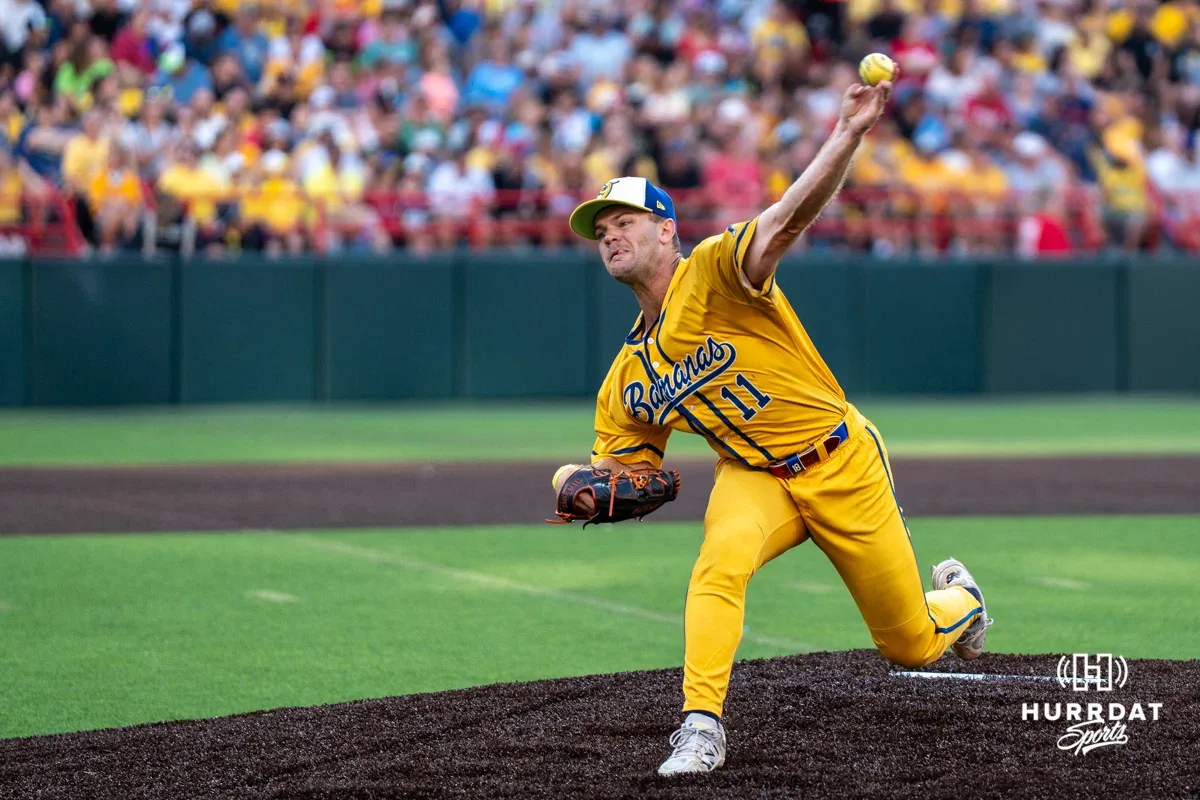
Austin Drury pitches in Omaha on June 13, 2026. Photo by Brandon Tiedemann for Hurrdat Sports.
Why the final inning changes the score
When a game approaches its end, find the point score first. Runs determine who wins an ordinary inning. In the final inning they also move the game score individually. Knowing which scoring rule is in effect tells you how many runs your team needs to catch up. The same rally can therefore mean one point earlier in a game and several near the end.
An ordinary inning awards one point
In an ordinary inning, the team that scores more runs earns the inning’s single point. Winning it by a run or a larger margin delivers the same point. A tied ordinary inning leaves the point score where it was because neither club won that inning. When you open a box score, both teams can have substantial run totals and a much smaller number of points. The points reflect how the games within the innings were decided, while the runs provide the detail behind those decisions. The Banana Ball stats guide explains where to find each number.
In the hypothetical below, the home team starts with two points and the visitors have four. The visitors score once in the inning and the home team scores three times. If it’s an ordinary inning, the home team wins the inning and gains one point, making its deficit one point. Keep track of who won that inning before adding anything to the overall score.
Every run counts in the final inning
The official scoring explanation says each run in the final inning adds a point. Apply that to the same made-up numbers: the visitors’ run moves them from four to five, and the home team’s three runs lift it from two to five. This time the teams are tied. Starting from the displayed points lets you use the example even if a real scoreboard has already reflected the league’s separate Trick Play Equalizer Point.
| Scoring mode | Points before the inning | Runs in the inning | Points after the inning |
|---|---|---|---|
| Ordinary inning | 2–4 | 3–1 | 3–4 |
| Final inning | 2–4 | 3–1 | 5–5 |
If you join the stream during a late at-bat, look for an indication that this is the final inning before applying the rules from the second row. The inning number alone can be an unreliable guide. Then follow the point score as each run comes home. An equalizer might have already moved the visitors’ total before the inning, so use the number the game displays when working out how many additional runs could level the score. A game tied in points after its last regulation play can proceed to a tiebreaker.
What happens if the game is tied
A last inning can settle a game if one team has more points when regular play ends. A tie sends the game to the Showdown, the league’s separate tiebreaker. This is the clearest example of why the two-hour rule and the length of a game answer different questions. You can see the end of regular innings and still have meaningful play ahead.
The Showdown replaces another regular inning
In the official Showdown explanation, the hitter faces a reduced defense. The two sides have chances to score under that round’s setup. In an early round, scoring earns a point, and the defense holding the hitter scoreless by getting an out is called a Showdown Shutdown. How many defenders are on the field and whether runners are placed on base depend on the round.
- Round 1: A hitter faces a pitcher, catcher and one additional fielder.
- Round 2: The defense uses only the pitcher and catcher. In each of the first two rounds, a team can earn up to one point.
- Round 3 and later: The extra fielder returns and the bases start loaded. Each run counts, up to four points per team in the round. If needed, the format continues until a winner is decided.
Look for the round number when the teams begin the tiebreaker. A game can be resolved in the first round. If the sides are still even, more rounds can follow, which makes the ending hard to put on a clock in advance. The league also specifies that an over-the-fence home run in a Showdown ends the game immediately. The Showdown rules guide goes through how outs, scoring chances and ball four work in those situations.
What the 2026 Banana Bowl line score shows
On October 10, 2026, the Texas Tailgaters and Savannah Bananas were tied 1–1 in points after nine innings at Nationals Park. The championship line score shows no point for either club in the ninth, then one for Texas in the Showdown. Nick Lopez scored the go-ahead point. Chris Clarke struck out Dan Oberst on Savannah’s turn to secure a 2–1 Texas win. The 2026 Banana Bowl recap covers the full event and the finish.
The game record lists a game time of 2 hours and 21 minutes and specifies that the result includes Showdown play. That is a recorded example of a game lasting longer than two hours. The line and summary show the order of the regular innings and tiebreaker, while the duration measures the archived game as a whole. It does not identify how many minutes the Showdown itself took. Use the phase column to identify where the last point came from. A numbered entry in a line score can carry a Showdown label and should be read with that label.
What to check when the broadcast clock is near two hours
Start by making sure you are watching the right game. The same clubs can play several times in one week, and a replay can begin on the same team channel as a live stream. Check the date, opponents and venue against the watch guide. The scheduled clock time tells you when to tune in. A video player’s elapsed time measures the video you have opened and can include material before the first pitch. The broadcast or ballpark announcement can tell you which stage of the game is underway.
- Read the point score. If the score graphic also shows runs, use points when deciding how much a trailing side needs to gain. If you have just joined, wait for the graphic or commentary to identify the relevant scoring format.
- Identify the inning or Showdown. If the broadcast says it is the final inning, follow each run as a point. If the teams have reached a Showdown, watch for the round and each side’s attempt. Those details tell you more about how the game can end than the number on your video bar.
- Check for a final result. For a live game, use the same-day game page to find the matchup, then give its official final status time to appear. A graphic showing a tie can still be accurate at the point in the game you are watching. The final score page can give a different number once the tiebreaker is decided.
Two September games show why the number of innings alone tells you little about duration. In the September 26, 2026 game at Globe Life Field, the record shows eight innings and a duration of 2 hours and 3 minutes. Texas won 3–0 on regulation points. The September 19 game at Grayson Stadium lists nine innings and 1 hour and 59 minutes, with Savannah winning 6–4 on regulation points. Both were decided in their regular innings, and only one recorded duration exceeded two hours.
Those summaries give you two measured examples. They do not tell you the instant an umpire designated the final inning. If you are discussing a close finish afterward, use the published duration, the decision type and the result as three separate details. For a game you are still watching, let the current phase and the point score tell you what can happen next.
How much time to leave for the whole event
A visit begins when you need to arrive, which may be well before the teams play. Start with the organizer’s Know Before You Go page for your date and venue. Look for the time you can enter, when the pregame activity begins, what the ticket says about a special experience, and the scheduled first pitch if it is listed. Those are separate appointments. Choose the earliest part of the event everyone wants to see, then work backwards from it to allow for travel, the entrance line and finding seats.
The organizer’s July 2026 Grayson Stadium guidance shows what those labels look like. Its Thursday–Saturday example lists the plaza at 4:30 p.m., gates at 5:30 p.m. and a show start at 6:30 p.m. A fan who arrives for the plaza would already have two hours of the trip behind them when the advertised show time comes around. The Sunday listing has a different set of times. Treat these as examples of how to read a guide, then verify the edition for your own game.
A stream can begin on yet another schedule. The Disney press listing for the 2026 Banana Bowl advertised a 6:30 p.m. Eastern stream start. The archived game record lists 7:10 p.m. for the game. Someone who watched the coverage from its announced beginning could see material that was outside the recorded game time. The complete runtime of a replay may also include the opening and closing segments. Use the archive’s game summary to compare competitive durations.
If your group has a firm ride or a last train, decide how much of the event to prioritize. Start with that departure time and allow room for reaching the exit, walking to transit and getting through any bottleneck. Give yourself a later option if you want to see a possible Showdown. If a fixed departure is unavoidable, have a meeting place or a plan to follow the final result after leaving. The time rule can make a stop easier to plan, but the last pitch and the trip to the parking lot can still happen later than you expected.
Check your ticket alerts before heading out. The organizer’s Victory Field guide gives a concrete example of updates through the app if weather affects game time or other event details. If a start or gate time moves, update the time at which your group will meet. Once play is underway, use the point score and the stage of the game to decide whether there may still be a tiebreaker to watch.
Comments
Comments are reviewed before publication. Spam, personal information and abusive content are not published.
Loading comments…